
Recently, Piscopia were featured in the Real Sociedad Matemática Española (RSME) weekly bulletin. Gemma (previous co-lead) and Rosie (current co-lead) were interviewed by the president of the RSME, Laura Saavedra, about what Piscopia does and our plans for the future.
You can read the original article (in Spanish!) over on the RSME website – https://www.rsme.es/wp-content/uploads/2024/02/Boletin-836.pdf.
Alternatively, you can read the English translation of the article below. This was kindly translated for us by Rachel Evans.
Piscopia, a support network for students and researchers in Mathematics
Elena Cornaro Piscopia (1646-1684) was a Venetian philosopher and the first woman in the world to obtain a doctorate. But Piscopia is also an initiative, created in the United Kingdom, with the aim of “encouraging women and non-binary students to pursue a doctorate in Mathematics and create a support network for students and researchers in Mathematics and related disciplines.”
We interviewed two members of Piscopia: Gemma Crowe, a doctoral student at Heriot Watt University who has been part of Piscopia in recent years, and Rosie Evans, a doctoral student at the University of Birmingham and current co-leader of the initiative. First, Gemma told us about the beginnings of Piscopia and what it consists of, and then Rosie spoke to us about their future plans and their expectations to expand this initiative worldwide.
Question: What is the Piscopia initiative about?
Answer: The Piscopia Initiative is a network of women and non-binary individuals in mathematics. The initiative has two main objectives to improve gender diversity in the field of Mathematics in the UK. The first is to increase the number of women and non-binary students considering and pursuing a doctorate or further studies in Mathematics. The second is to create a welcoming community that serves as support to encourage gender minorities to continue their mathematical activity.
Q: When did it start and what motivated the idea of Piscopia?
A: The initiative was born in 2019 thanks to three doctoral students in Mathematics from the University of Edinburgh: Bella, Mary, and Tiffany. Their motivation was the significant gender gap that existed among students, both undergraduate and doctoral, in Mathematics.
Q: Can you tell us about its beginnings? I imagine establishing a network like Piscopia must not have been easy and probably came with some controversy. Have you encountered difficulties or opposition in its creation?
A: Overall, Piscopia has received a great deal of support from institutions across the UK. The University of Edinburgh stands out, not only providing generous funding and great support when the initiative started in 2019 but also continuing to support Piscopia. For example, this year they have paid Piscopia volunteers to hold events on behalf of the University of Edinburgh.
There have been some difficulties along the way; for instance, some institutions have provided much less support and economic backing than others. Additionally, it has been challenging to maintain volunteers since all our volunteers are doctoral students and dedicate their own time to assisting with Piscopia events.
Q: What is the main source of funding: public or private? Was it difficult to secure funding and support for Piscopia?
A: Our main source is from institutions in the UK. We aim for all local committees to obtain funding from their own institutions. This is often achieved through equality, diversity, and inclusion funds at each university. For larger events across the UK, we have received financial support from groups such as the London Mathematical Society, the Heilbronn Institute, and the Edinburgh Maths Society. Our main challenge is finding long-term funding. For example, our website requires financial input every two years, and so far, the London Mathematical Society has provided this support. It is also difficult to ensure long term funding as our volunteers are doctoral students who naturally do not remain at their institutions long-term.
Q: Why do you think this initiative is necessary?
A: Although the gender gap is improving in Mathematics, it is doing so at a very slow pace. This initiative is unique in that it focuses specifically on Mathematical Sciences, and the volunteers are doctoral students themselves. We find this to be more productive for undergraduate students to open up and ask questions about doctoral studies. Overall, there is a knowledge gap about academic career paths in Mathematics that we are trying to improve by providing information and advice based on our experiences.
This initiative is unique in that it focuses specifically on Mathematical Sciences, and the volunteers are doctoral students themselves.
Q: What kind of activities do you carry out?
A: Piscopia organizes various events, both locally and across the UK. Locally, committee members organize events such as informative talks about doctoral studies. These can be in the form of informal seminars or question-and-answer sessions, or perhaps a talk over a coffee break with doctoral students. We have found that more informal events have been more successful.
At the national level, we first have the monthly PiWORKS seminar. The aim of this online seminar is to promote and showcase the work of women and non-binary individuals in Mathematics. We invite speakers from a wide range of different areas in Mathematics and different institutions to describe both their research and their professional trajectory. We also organize unique special events, such as our “Non-traditional Career Paths” event, where we invite four speakers who have not followed the linear or usual trajectory in Mathematics.
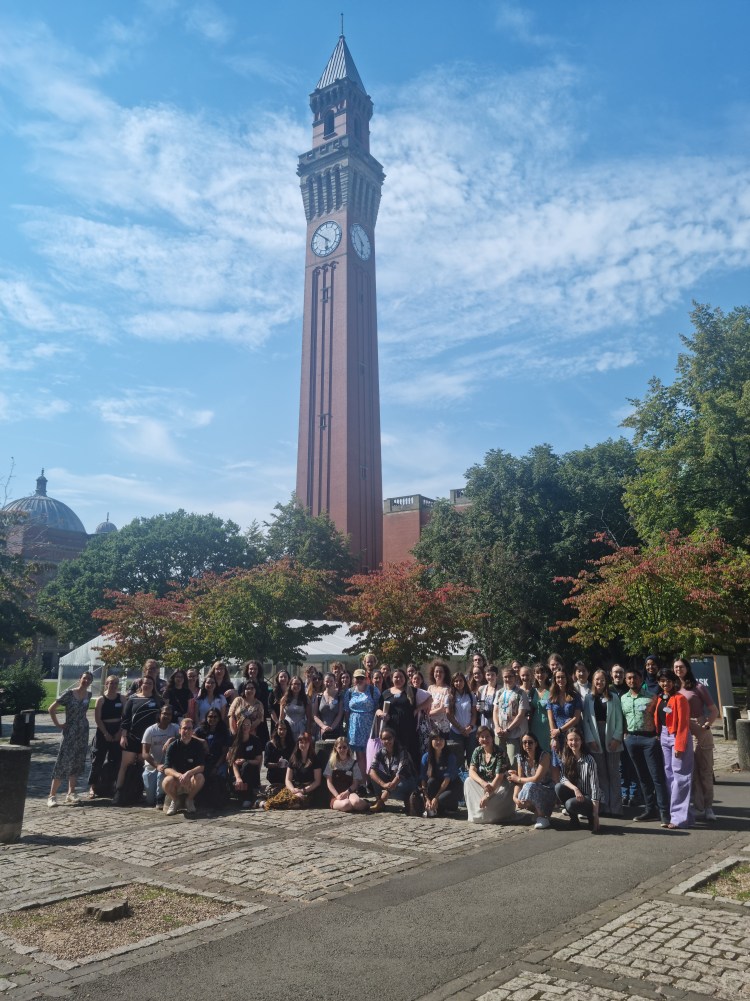
Finally, we have the annual PiFORUM conference that brings together members of the Piscopia community from across the UK to discuss mathematical issues and some of the challenges faced by gender minorities in Mathematics. In 2023, we held our conference in Birmingham, and the event consisted of short doctoral talks, career panels, discussions on challenges in academia, and a poster session.
Q: We’ve seen that the initiative is spreading throughout the UK. What is the organizational structure of Piscopia?
A: Piscopia has some main coordinators who oversee the functioning of Piscopia across the UK. Then, there are several members of the local committee in institutions across the UK, who organize local Piscopia events at their respective universities. Local committee members report to the main coordinators about their events and, in turn, provide feedback to other members of other local committees. The main coordinators also organize events across the UK, including the monthly PiWORKS seminar and the annual PiFORUM conference.
Q: The number of women pursuing doctoral degrees in Mathematics in the UK is very small, similar to the situation in Spain, despite there being a comparable number of men and women in the field. Why do you think this happens in the UK? Do you think this extends to other countries?
A: I believe there simply isn’t enough support in the UK to support women and non-binary individuals in mathematics beyond the undergraduate level. A key issue is the lack of guaranteed job opportunities in academia, which is a problem worldwide. Mathematicians are expected to travel during their research careers, something that is often not possible or more difficult for women or anyone with personal ties involving caregiving responsibilities. More support is needed, in the UK and worldwide, both to encourage women and non binary individuals to pursue careers in academia and to help them stay in academia if they so desire. There also needs to be better global awareness of the problem. Too many mathematicians still do not see this as a problem and therefore do not see the need for anything to change.
Too many mathematicians still do not see this as a problem and therefore do not see the need for anything to change.
Q: Although it might be too early to tell, and we know that changes take time, do you have any data indicating an increase in the number of women pursuing doctoral degrees thanks to Piscopia?
A: We don’t have data as such in terms of the impact of the Piscopia initiative; however, we have received positive feedback from students who have indeed pursued a doctoral degree in Mathematics after attending a Piscopia event.
At this point in the interview, both Rosie and Gemma have told us personal stories of women and non-binary students who have started their doctorate thanks to attending events organized by Piscopia, especially following the smaller events. Some of them have even secured funding, such as scholarships from the Martingale Foundation, thanks to the information and support provided by the initiative. We won’t mention them to maintain their privacy, but certainly, these kinds of successes are what encourage an initiative like Piscopia to continue. They should also encourage us to support similar initiatives in Spain.
Finally, Rosie Evans tells us about Piscopia’s future plans. First, they aim to solidify their structure in the UK, although they have already begun contacts to expand worldwide. Some of the Piscopia leaders have reached out to universities in the United States and the Netherlands where it is currently more feasible to establish Piscopia branches. They have offered us the possibility of giving talks at our universities to encourage us to participate in Piscopia and share their experiences.
The best advice we can give to other women is to find community,
however you can. Talking to friends when you’re stuck in your research really helps.
What do you think of the initiative? We loved it and would like to participate in it from Spain, as well as integrate similar initiatives being promoted from here. We echo Piscopia’s words: “the best advice we can give to other women is to find community, however you can. Talking to friends when you’re stuck in your research really helps.” We believe that the only way to promote equality is by creating community, creating support networks, and working together so that women starting on this path, and those of us who have been on it for a while, feel supported at every step.
We encourage you to follow them on social media:
And write to us at mymcomision@gmail.com to tell us about similar initiatives you are carrying out, if you feel like starting one, or even if you would like to participate in Piscopia.
Original article written by Laura Saavedra.
 piscopia.co.uk